



Why Most Bot Traffic Shows 0-Second Engagement Time in Google Analytics — and How TrafficBotPro Solves It
For anyone who has experimented with traffic generation tools, one frustrating pattern appears again and again inside Google Analytics:
The visits are counted, but engagement time remains stuck at 0 or 1 second.
At first glance, the traffic looks real — pageviews increase, sessions appear, and sometimes even referrers show up correctly. But once you open the engagement reports, the truth becomes obvious: the visits are not behaving like real users.
For website owners, marketers, and SEO professionals, this creates a serious problem. Modern analytics systems don’t just measure visits anymore. They measure behavior quality.
If the engagement metrics look artificial, the traffic becomes useless.
In this article we’ll explore:
Why most traffic generation tools fail to produce engagement time
How engagement time is actually measured
Why traditional bot traffic gets flagged instantly
And how TrafficBotPro simulates real user interaction so engagement time is recorded naturally.
The Industry Problem: Fake Traffic That Looks Alive But Behaves Like a Ghost
Most traffic bots follow a very simple logic:
Launch a headless or background browser
Load a webpage
Close the page after a short delay
From a raw network perspective, this counts as a visit. But modern analytics systems — especially those owned by Google — no longer rely on page loads alone.
They track active user engagement.
This is why traffic from many tools produces results like:
| Metric | Result |
|---|---|
| Sessions | ✔ counted |
| Pageviews | ✔ counted |
| Engagement Time | ❌ 0s or 1s |
| Active Users | ❌ rarely counted |
The reason is simple:
The browser session never becomes an active user session.
Most automation tools run pages in:
background tabs
headless browsers
minimized windows
inactive rendering states
From the perspective of analytics tracking scripts, the page is not actively viewed by a human.
So the session never generates meaningful engagement signals.
Understanding Engagement Time: How Analytics Actually Measures It
In modern analytics systems like Google Analytics 4, engagement time is not simply calculated by measuring how long a page is open.
Instead, it measures active user interaction time.
Several browser signals are used to determine whether a user is truly engaged with a page:
1. Page Visibility State
Browsers expose an API called Page Visibility.
If a tab is hidden, minimized, or running in the background, the page enters a state like:
document.visibilityState = "hidden"
Analytics scripts stop counting engagement when this happens.
Only when the state is:
document.visibilityState = "visible"
does engagement time increase.
This is one of the biggest reasons many traffic bots fail.
They open dozens of tabs in parallel — but only one tab can actually be visible.
2. Window Focus Detection
Modern analytics scripts also monitor focus state.
When the browser window is inactive, scripts detect it using events such as:
window.onblur
window.onfocus
If the page loses focus, engagement tracking pauses.
Most automation frameworks never simulate focus switching correctly.
3. User Activity Signals
Analytics systems also track behavioral signals such as:
mouse movement
scrolling
clicks
keyboard events
viewport changes
These events confirm that the user is interacting with the page.
Without them, the system assumes the page is idle.
4. Event Heartbeats
Google Analytics sends periodic events when engagement is detected.
If no interaction occurs within a certain timeframe, engagement tracking stops.
This is why sessions often end up showing 1 second of engagement.
The page loaded — but no real activity followed.
Why Traditional Traffic Bots Fail
Most traffic tools were originally designed years ago, when analytics systems were much simpler.
They relied on:
HTTP requests
headless browsers
page load simulation
But modern detection logic focuses on behavioral authenticity.
Here are the typical problems seen in traditional traffic tools:
Problem 1: Background Tab Execution
Automation frameworks often launch many tabs simultaneously.
Only one tab is truly visible.
The rest remain hidden, meaning engagement tracking never activates.
Problem 2: No Real User Interaction
Many bots simply:
open page → wait → close
But real users:
move the mouse
scroll
click links
pause while reading
Without these signals, analytics systems recognize the session as inactive.
Problem 3: Static Timing Patterns
Fake traffic often has predictable timing patterns:
exactly 5 seconds on page
identical interaction intervals
synchronized browsing behavior
Real user activity is far more chaotic.
How TrafficBotPro Simulates Real Engagement
TrafficBotPro was designed specifically to address these limitations.
Instead of merely loading pages, it recreates the full browsing behavior of real users.
The system focuses on three key layers:
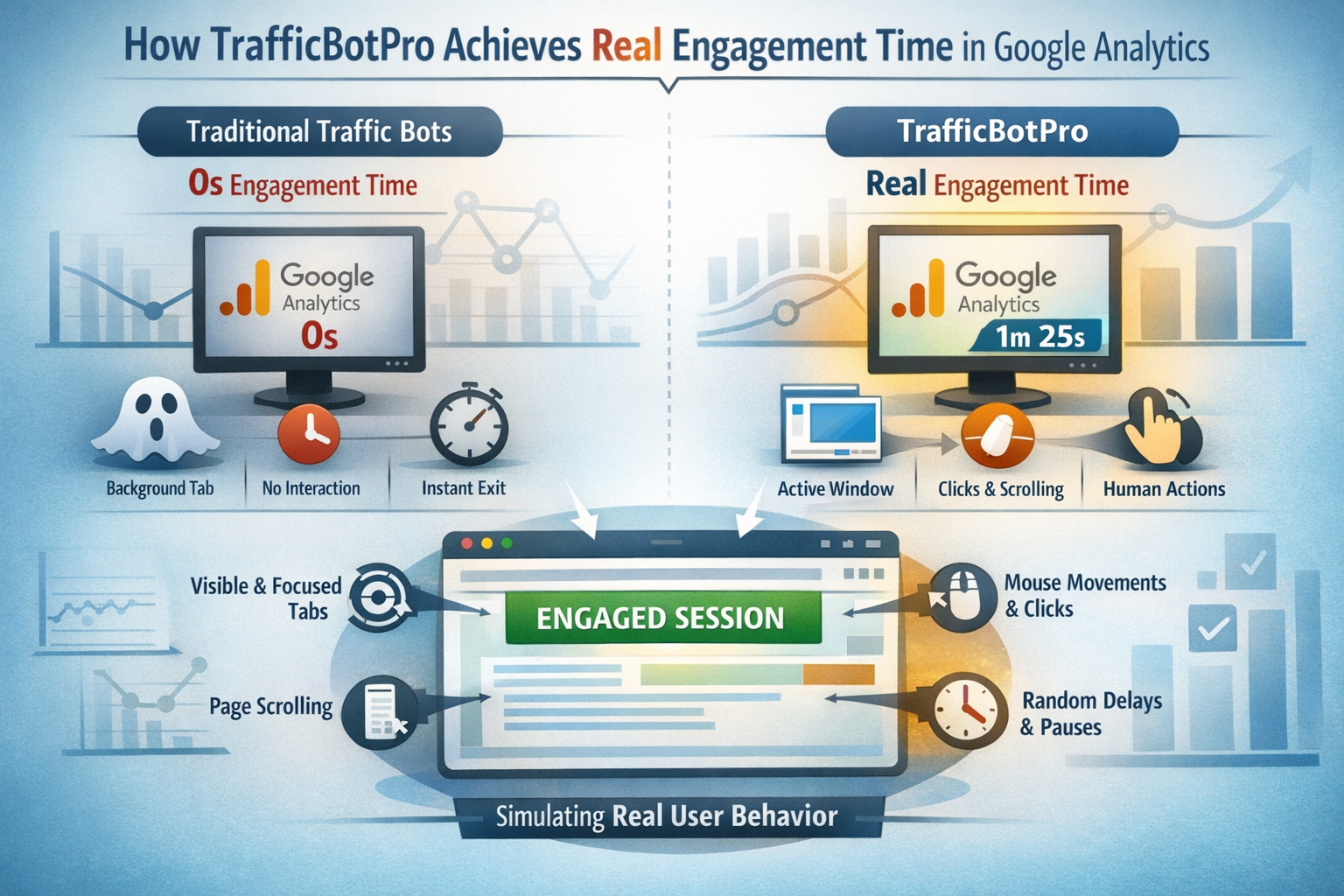
1. True Active Window Execution
Unlike traditional tools, TrafficBotPro ensures that every browser instance operates in an active state.
Each window:
remains focused
stays visible
maintains active rendering
This allows engagement timers inside analytics platforms to start counting naturally.
Rather than background execution, the browsing environment behaves like a real user actively viewing the page.
2. Behavioral Interaction Simulation
TrafficBotPro also introduces automated behavioral patterns such as:
mouse movement across the page
random scroll depth
click interactions
hover pauses
reading delays
These behaviors are not simple scripts.
They are randomized and structured to resemble natural browsing patterns.
This allows analytics systems to register:
user activity
interaction events
active engagement signals
As a result, engagement time increases normally.
3. Multi-Threaded Focus Management
One of the most technically challenging problems in traffic simulation is focus management.
Browsers only allow one tab to truly hold focus at a time.
TrafficBotPro solves this by orchestrating multiple browser instances in a way that ensures each one maintains its own active focus cycle.
This means:
multiple sessions can run simultaneously
each session appears actively viewed
engagement signals remain valid
Testing Engagement Detection Yourself
If you're curious how engagement detection works, you can test it directly using the diagnostic page below:
https://trafficbotpro.com/tab.html
This page displays real-time browser status signals such as:
tab visibility
window focus
active interaction state
When traffic tools open the page in background tabs, the detection panel immediately shows:
Hidden tab detected
Inactive window
No user activity
But when TrafficBotPro runs the same page, the status indicators remain active because the browser behaves like a real user session.
This simple test demonstrates why most bots fail — and why proper behavioral simulation matters.
Why Engagement Time Matters More Than Ever
Modern analytics platforms evaluate traffic quality using multiple engagement signals:
engagement time
bounce behavior
scroll depth
event triggers
interaction frequency
Traffic that produces 0-second sessions immediately raises suspicion.
For website owners running advertising, SEO campaigns, or user behavior experiments, realistic engagement metrics are essential.
Without them, traffic becomes statistically meaningless.
The Future of Traffic Simulation
Traffic generation has evolved from simple page loading to behavioral environment simulation.
Tools that fail to replicate real browser states will increasingly produce useless analytics data.
TrafficBotPro approaches the problem differently by focusing on:
real browser environments
active user simulation
authentic engagement signals
The result is traffic that not only appears in analytics reports — but behaves like genuine user activity.